Model A
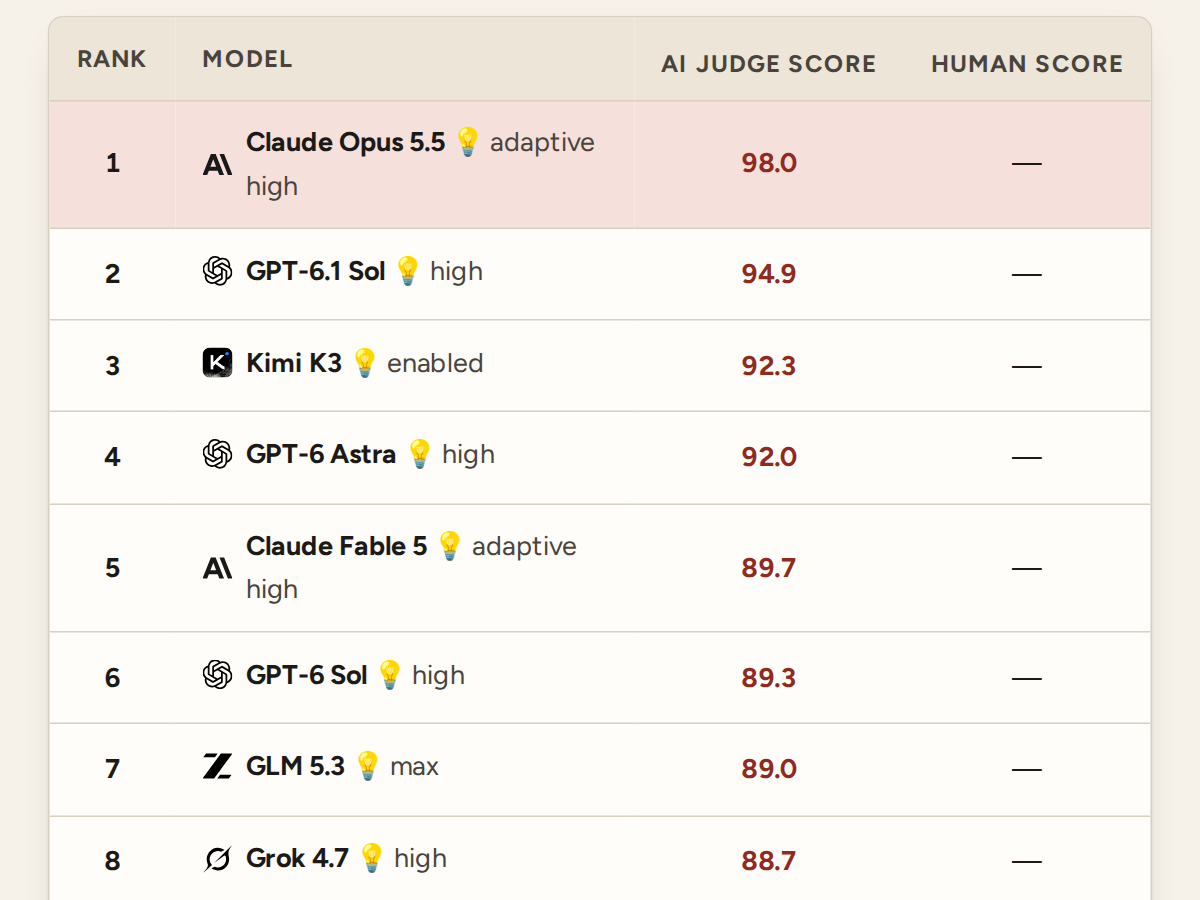
 GPT-6.1 Sol 💡
- Rank
- 1
- AI judge score
- 95.7
- Human score
- —
- Ranking duels
- 2,597
- 95% interval
- 95.0–96.3
Compare two models in detail: their results, direct record, and published writing examples.
Model A
GPT-6.1 Sol 💡Model B
 Claude Opus 5.5 💡
GPT-6.1 Sol by OpenAI (thinking high) earns 44.4% of the available points against Claude Opus 5.5 by Anthropic (thinking adaptive high).
8 wins · 0 ties · 10 losses · 18 published duels.
Prompt
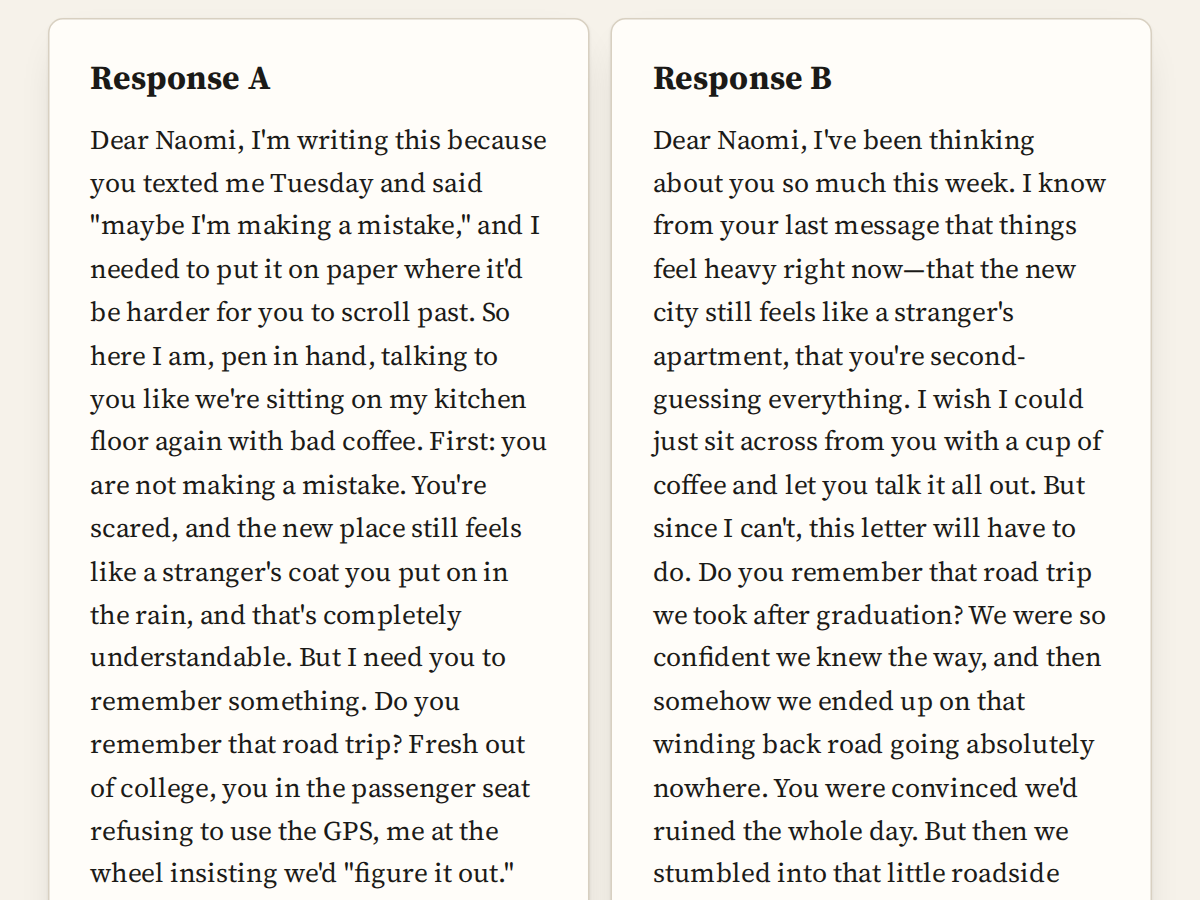
Write a very short screenplay scene (50–150 words) in standard screenplay format, including a scene heading and character cues. The setting is a late-night diner where a tired waitress named Marla tries to convince the only remaining customer, an out-of-towner named Chris who has missed the last bus, that the couch in the back is safer than walking three miles in the dark. Keep the dialogue natural and slightly wry, and let a small detail hint that Marla has done this before.
Published verdict: Advantage to model A (judged by GPT-6 Sol).
GPT-6.1 Sol 💡INT. ROADSIDE DINER - NIGHT
MARLA rubs her eyes behind the counter. CHRIS, the only customer, pulls on his coat.
CHRIS
Motel’s three miles. I can walk.
MARLA
You can. There’s no shoulder after
the bridge, though.
CHRIS
Last bus really means last bus here?
MARLA
We’re pretty literal.
She lifts the counter flap.
MARLA
There’s a couch in back. Safer than
finding out how fast the trucks go.
Chris looks toward the dark windows.
CHRIS
You sure I’m not putting you out?
MARLA
I’m putting you on a couch.
Different thing.
She opens a drawer beside the register: several wrapped toothbrushes.
MARLA
Bathroom’s on the left.
Claude Opus 5.5 💡INT. BIRDIE'S DINER - NIGHT
Rain ticks against the windows. MARLA (50s) wipes the counter around CHRIS (30s), who nurses cold coffee beside a duffel bag.
CHRIS
It's three miles. I've walked farther.
MARLA
In daylight. Without the Hendricks' dogs.
CHRIS
The dogs are a factor?
MARLA
The dogs are the whole factor.
Marla reaches under the register and pulls out a folded blanket and a toothbrush still in its wrapper. A strip of masking tape on the blanket reads: GUEST #14.
CHRIS
Fourteen?
MARLA
Fifteen tonight. I'll need more tape.
Chris eyes the dark door, then the blanket.
CHRIS
Does the couch have springs?
MARLA
Two. You'll meet them.
How to read this page: AI and human scores remain separate. The AI score uses the main-leaderboard scale, not a percentage grade: for the selected category, 50 means an estimated one-in-two chance of beating the average English-writing model. The direct record uses only protocols compatible with the main ranking and never mixes reasoning modes.
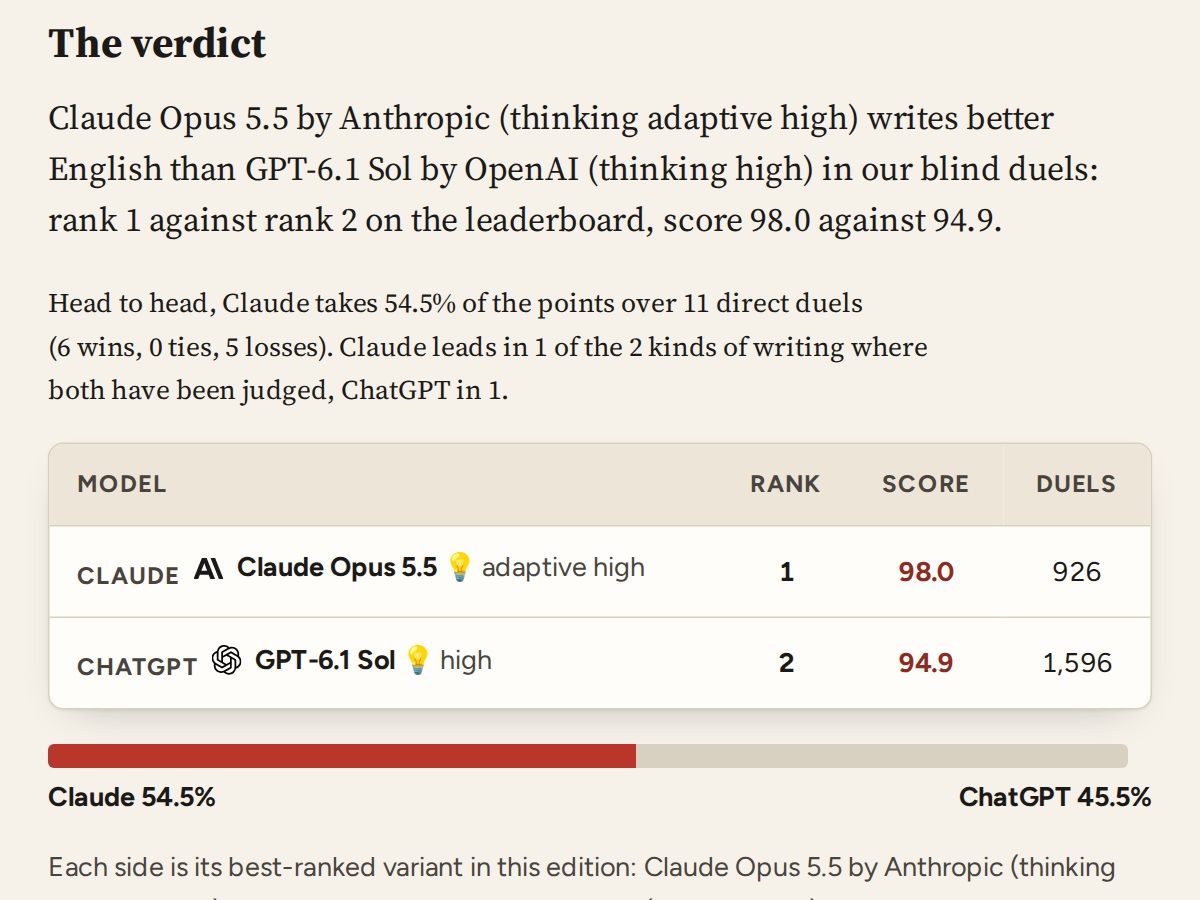
The two most-asked-about assistants, judged on the same English prompts in blind duels: which one writes better, by how much, and for which kinds of text. Updated with every export of the ranking.
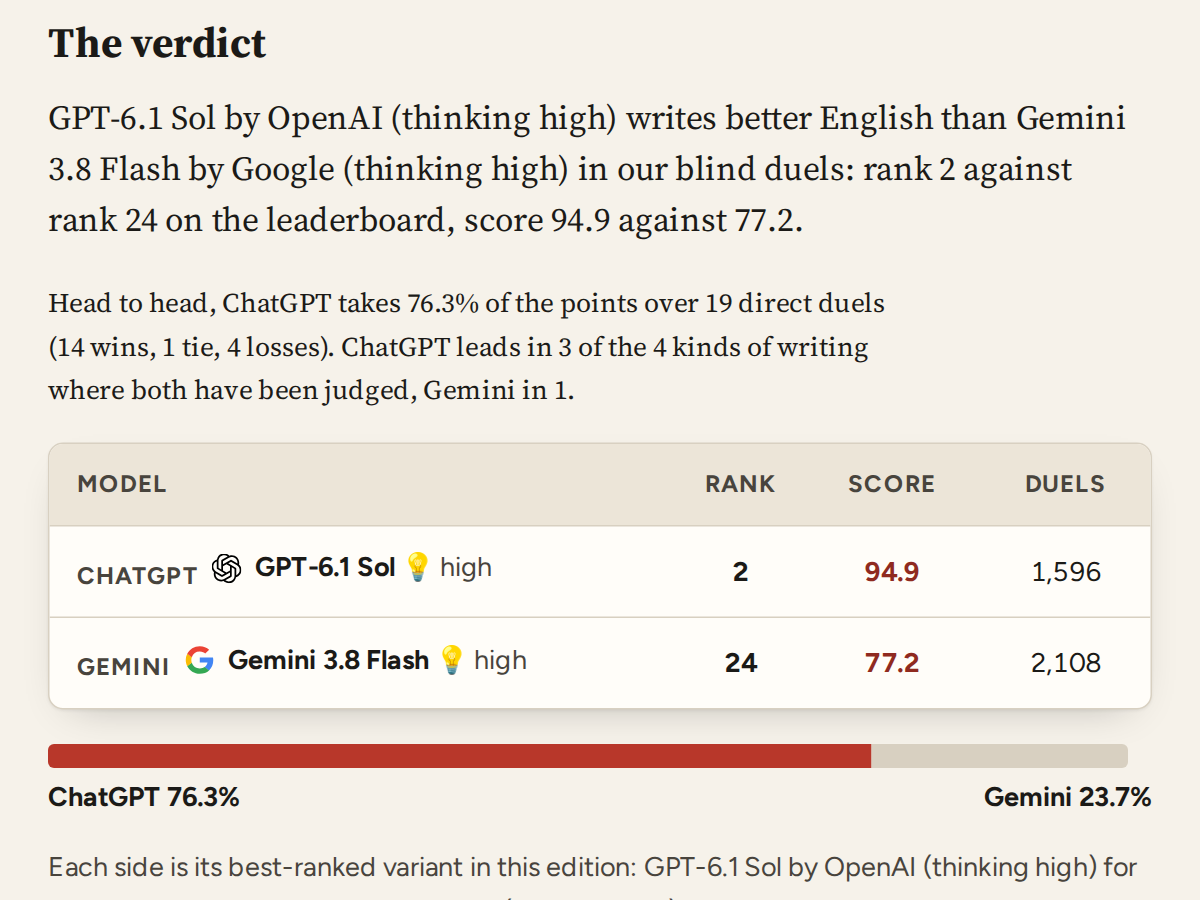
OpenAI's best model against Google's best, on the same English prompts, in blind duels: who leads on the leaderboard, how the direct duels went, and where each one is stronger.
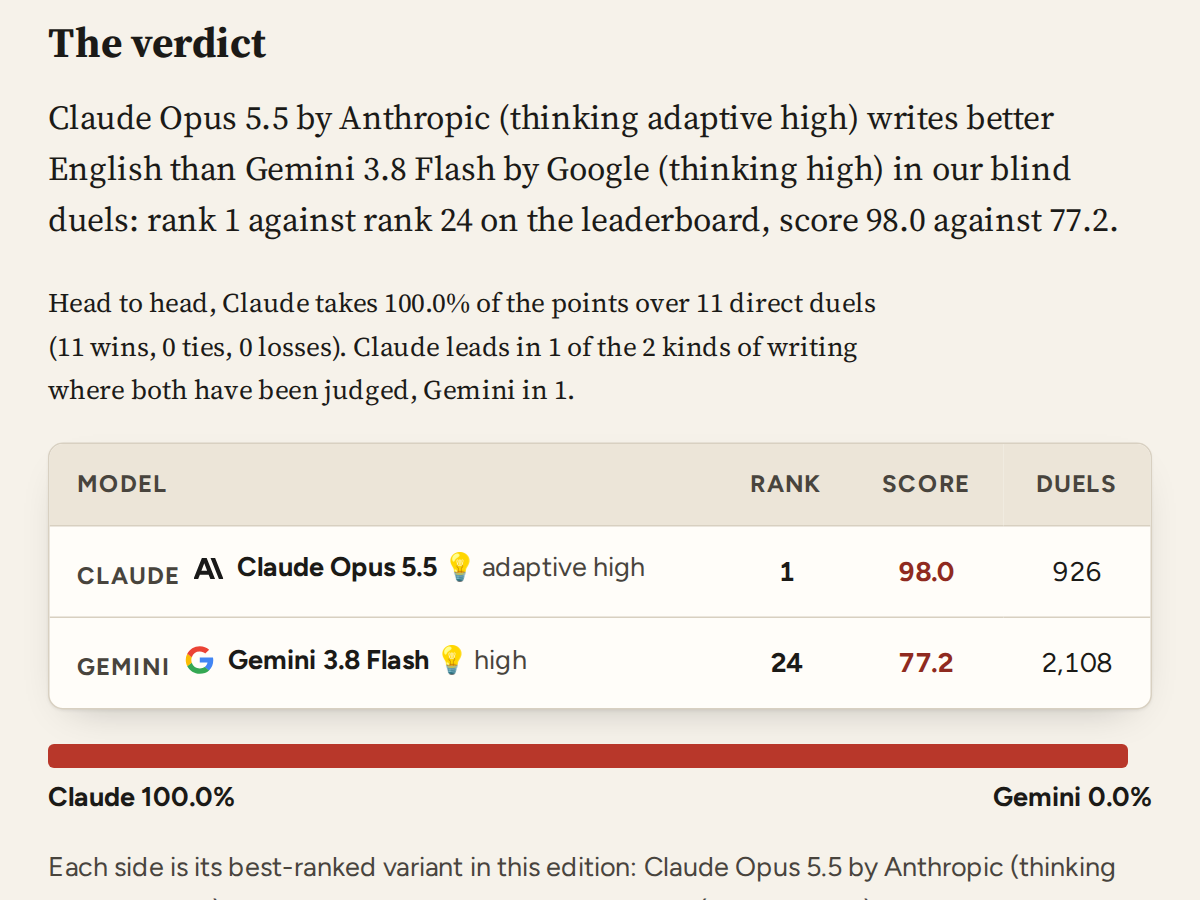
Anthropic's best model against Google's best, on the same English prompts, in blind duels: the gap on the leaderboard, the direct record, and the kinds of writing where Gemini comes closest.
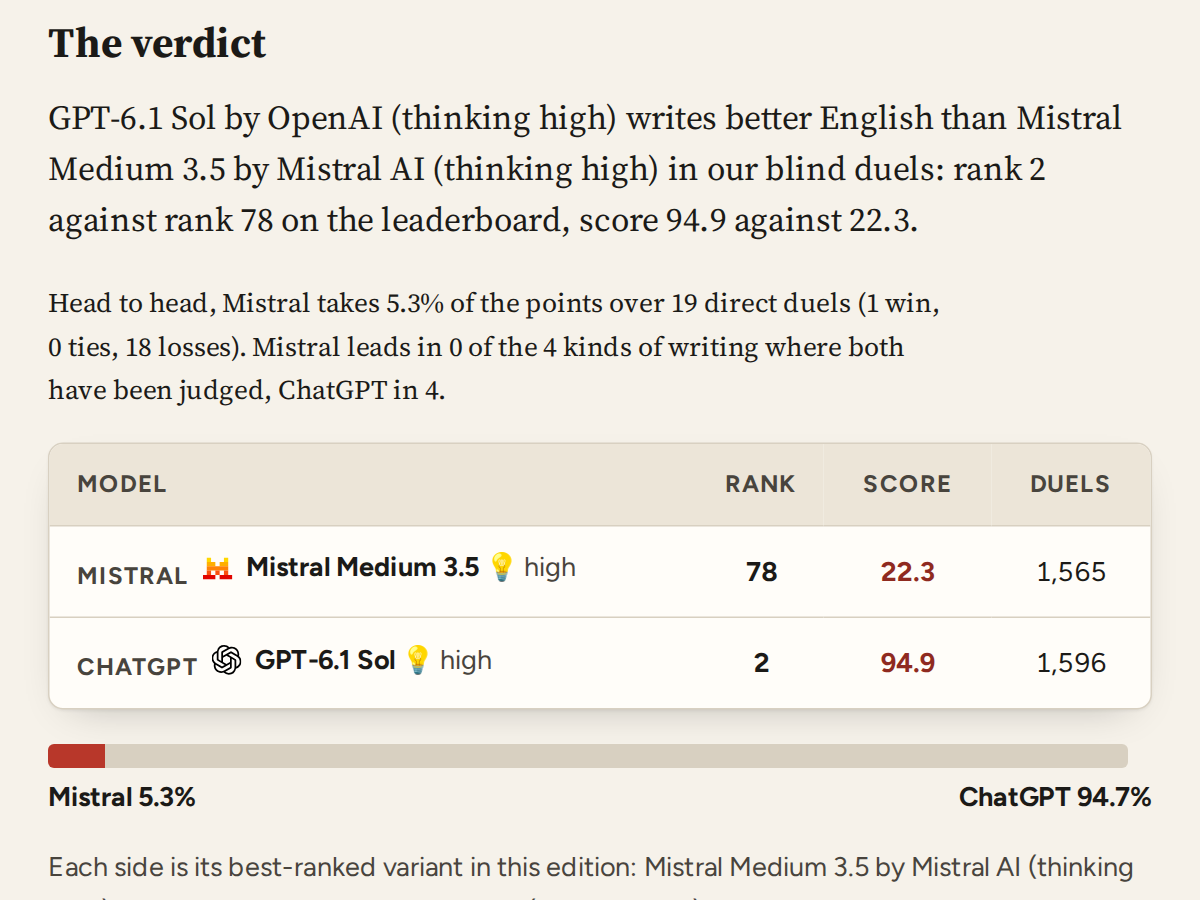
The European contender against the market leader, on the same English prompts, in blind duels. The gap is larger than the marketing suggests; this page shows how large, and in which kinds of writing.
The two open-weight families most people download, run on our own machine and judged on the same English prompts in blind duels: which one writes better, in which kinds of text, and what it costs in memory.
Every model ranked on English writing, with filters by kind of writing, publisher, size, reasoning mode and quantization, and the duel matrices.
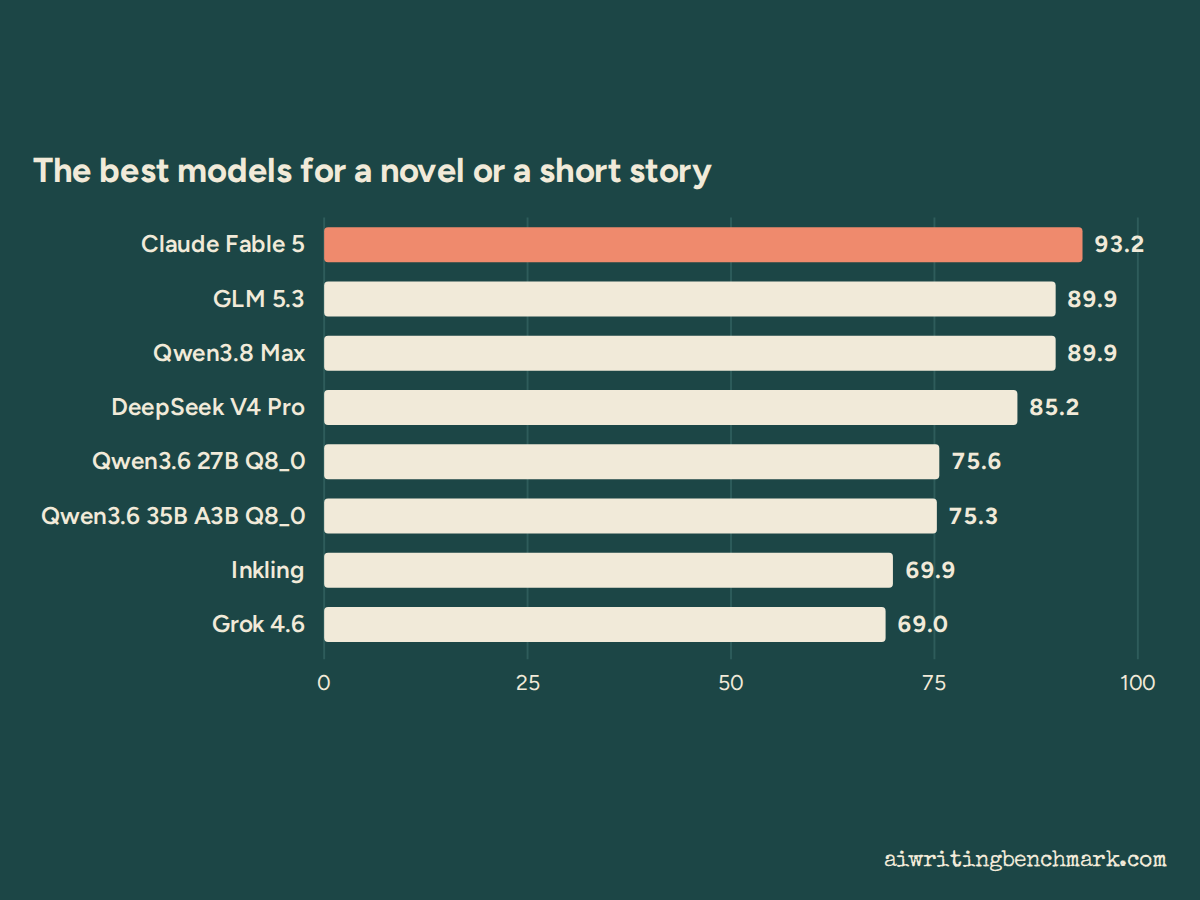
The leaderboard has one winner; your writing does not. On the duels of one kind of text alone, GPT-5.6 Sol takes fiction, Claude Opus 5 personal letters, Kimi K3 formal correspondence, and a local file you can run at home is second for cover letters. A plain guide, task by task.
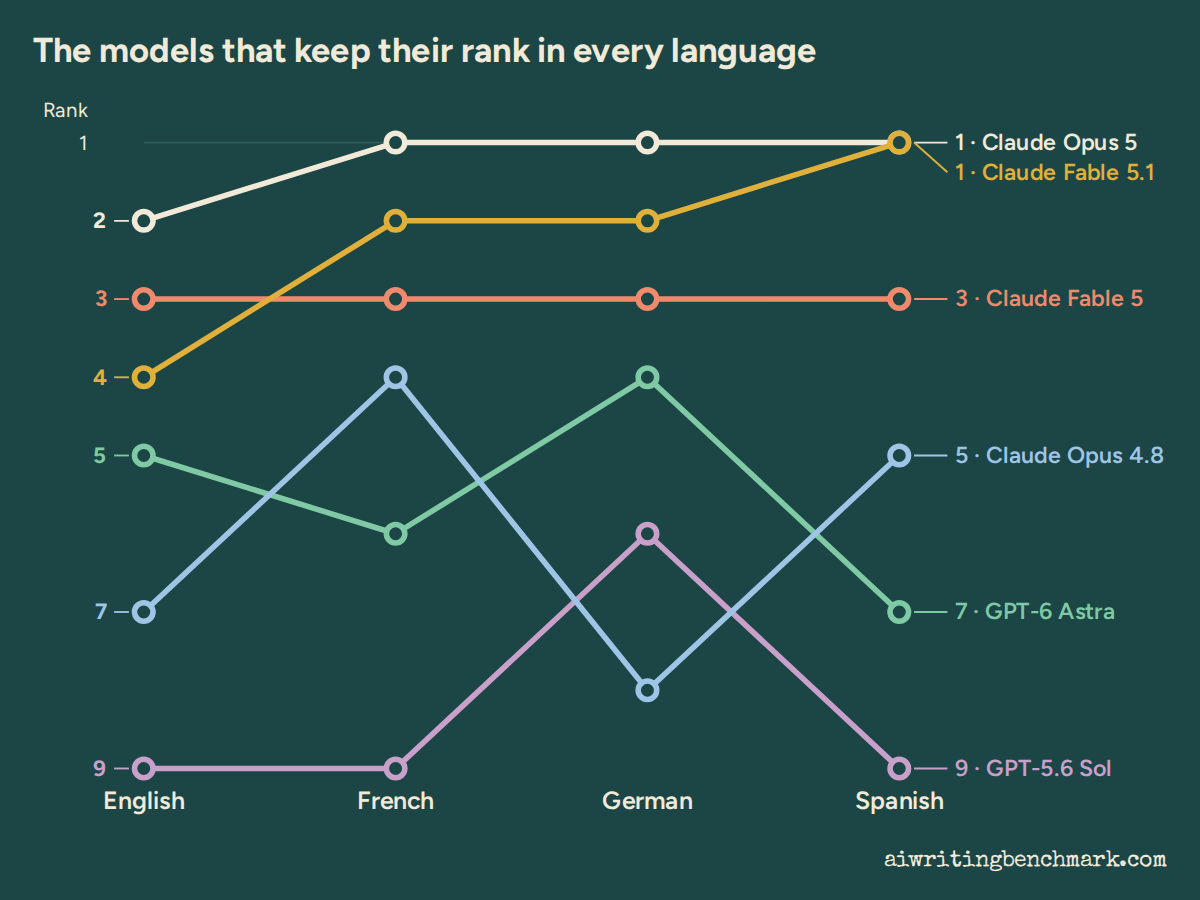
Ninety-one models are ranked in English, French, German and Spanish on the same protocol. Claude Fable 5 is third in all four; Claude Opus 5 first or second. Below the top, GLM 5.3 Flash is 10th in English and 54th in German, Grok 4.6 25th in English and 60th in French, and the best local model is a different model in every language.
One prompt, two anonymous texts: pick the better one and feed the human ranking. The model names appear after your choice.