Strix Halo is the code name of AMD’s Ryzen AI Max series, the first PC chip with enough unified memory to hold models that used to need a rack of graphics cards. Our machine is a Framework Desktop: 16 cores, an integrated Radeon 8060S and 128 GB of LPDDR5X shared between processor and graphics. It is a common configuration, a little over €2,000, and the question people ask about it is always the same: what can it run, and how fast?
We can answer with measurements rather than estimates, because the benchmark itself generated thousands of texts on it. The table gives, for each model file we tested, the median tokens per second over the valid responses generated on this machine, reasoning tokens included, next to the file size, the memory needed with a full 128,000-token context, and the model’s writing score on this edition’s leaderboard.
| Model | Median tok/s | File (GB) | +128K (GB) | Parameters | Score | Responses |
|---|---|---|---|---|---|---|
 Gemma 4 26B A4B 💡 🏠 | 39.8 | 28.1 | 31.0 | 26.0 B (4.0 B active) | 41.3 | 465 |
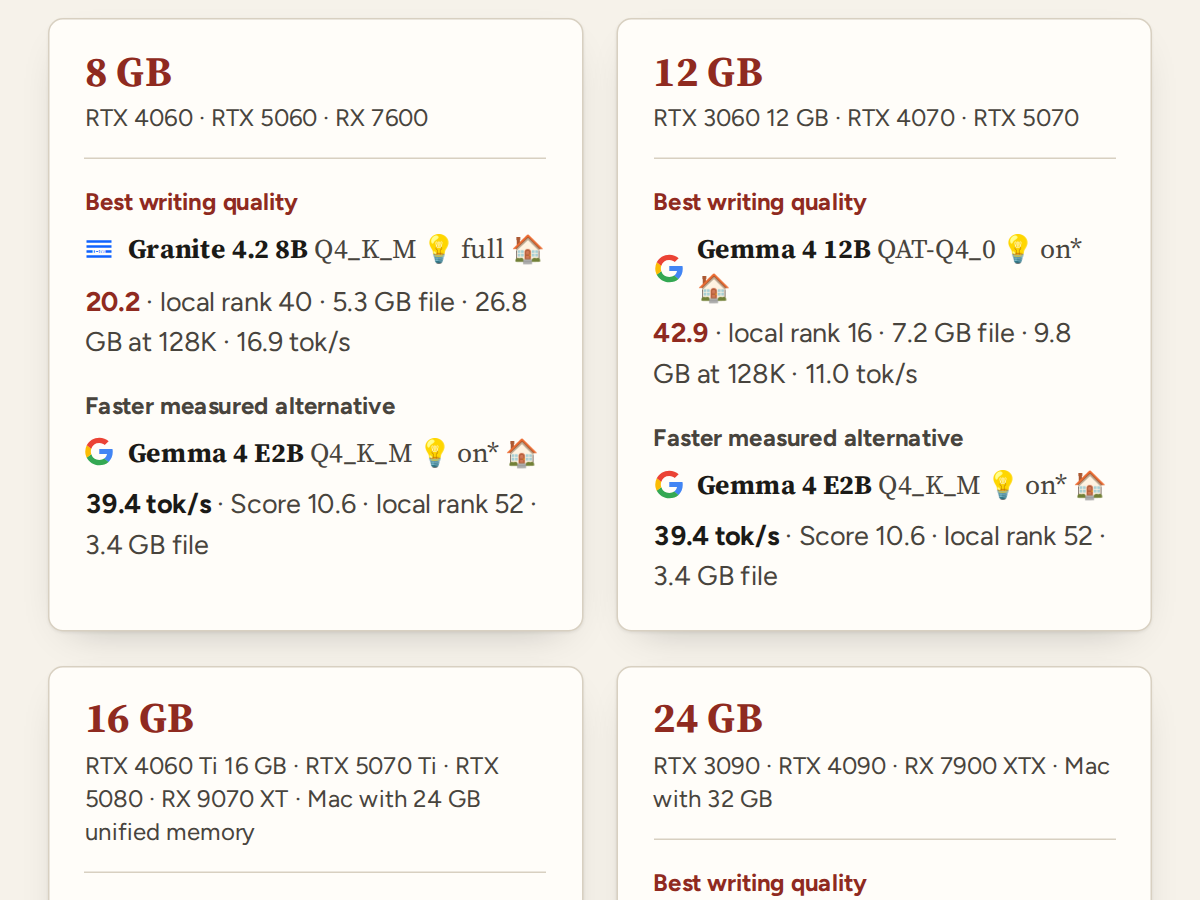
| Gemma 4 E2B 💡 🏠 | 39.4 | 3.4 | 5.3 | 5.1 B | 10.4 | 224 |
| Gemma 4 E4B 💡 🏠 | 35.9 | 8.0 | 11.9 | 8.0 B | 13.4 | 542 |
| Gemma 4 E2B 💡 🏠 | 33.2 | 3.9 | 5.8 | 5.1 B | 10.9 | 216 |
 Ling 3.0 Flash 💡 🏠 | 31.6 | 77.0 | 78.2 | 124.0 B (5.1 B active) | 25.8 | 277 |
| Ling 3.0 Flash ↯ 🏠 | 30.5 | 77.0 | 78.2 | 124.0 B (5.1 B active) | 36.2 | 240 |
| Gemma 4 E2B 💡 🏠 | 29.2 | 5.0 | 6.9 | 5.1 B | 16.6 | 224 |
| Gemma 4 26B A4B 💡 🏠 | 27.9 | 15.6 | 18.6 | 26.0 B (4.0 B active) | 38.1 | 118 |
 Qwen3.6 35B A3B 💡 🏠 | 26.6 | 22.1 | 24.8 | 35.0 B (3.0 B active) | 41.8 | 347 |
 Nemotron 3 Nano Omni 30B A3B 💡 🏠 | 25.1 | 26.1 | 27.0 | 30.0 B (3.0 B active) | 14.7 | 960 |
| Gemma 4 E4B 💡 🏠 | 22.4 | 6.3 | 10.2 | 8.0 B | 10.7 | 221 |
| Qwen3.6 35B A3B 💡 🏠 | 22.1 | 37.8 | 40.6 | 35.0 B (3.0 B active) | 47.5 | 312 |
| Nemotron 3 Nano Omni 30B A3B 💡 🏠 | 21.2 | 35.2 | 36.1 | 30.0 B (3.0 B active) | 18.4 | 391 |
| Nemotron 3 Super 120B A12B 💡 🏠 | 21.1 | 86.1 | 87.5 | 120.0 B (12.0 B active) | 28.2 | 413 |
| Gemma 4 26B A4B 💡 🏠 | 20.2 | 23.8 | 26.8 | 26.0 B (4.0 B active) | 50.8 | 539 |
| Gemma 4 E4B 💡 🏠 | 18.6 | 6.2 | 10.1 | 8.0 B | 14.5 | 218 |
 Granite 4.2 8B 💡 🏠 | 16.9 | 5.3 | 26.8 | 8.0 B | 17.9 | 36 |
| Gemma 4 12B 💡 🏠 | 14.6 | 12.7 | 15.3 | 12.0 B | 41.3 | 124 |
| Gemma 4 12B 💡 🏠 | 11.0 | 7.2 | 9.8 | 12.0 B | 41.7 | 752 |
| Gemma 4 31B 💡 🏠 | 10.0 | 17.7 | 29.6 | 31.0 B | 51.5 | 548 |
| Gemma 4 12B 💡 🏠 | 9.0 | 9.8 | 12.4 | 12.0 B | 42.2 | 216 |
| Qwen3.8 27B 💡 🏠 | 8.9 | 17.7 | 26.5 | 27.0 B | 58.7 | 546 |
 Muse Glimmer 30B 💡 🏠 | 8.8 | 18.2 | 20.0 | 29.6 B | 61.4 | 394 |
| Qwen3.8 27B 💡 🏠 | 8.4 | 30.0 | 38.7 | 27.0 B | 57.4 | 498 |
| Muse Glimmer 30B 💡 🏠 | 8.0 | 21.1 | 22.9 | 29.6 B | 72.4 | 397 |
| Granite 4.2 30B 💡 🏠 | 7.6 | 17.7 | 52.1 | 30.0 B | 11.8 | 423 |
| Qwen3.6 27B 💡 🏠 | 7.5 | 28.6 | 37.3 | 27.0 B | 58.5 | 190 |
| Qwen3.8 27B 💡 🏠 | 7.0 | 23.4 | 32.1 | 27.0 B | 56.4 | 504 |
| Granite 4.2 30B 💡 🏠 | 6.6 | 24.0 | 58.4 | 30.0 B | 19.5 | 397 |
| Gemma 4 31B 💡 🏠 | 5.8 | 26.4 | 38.4 | 31.0 B | 53.9 | 527 |
| Qwen3.6 27B 💡 🏠 | 5.2 | 16.5 | 25.3 | 27.0 B | 51.6 | 588 |
| Granite 4.2 30B 💡 🏠 | 4.9 | 31.1 | 65.5 | 30.0 B | 25.7 | 447 |
| Gemma 4 31B 💡 🏠 | 4.8 | 33.8 | 45.8 | 31.0 B | 53.5 | 316 |
No measurement matches these filters.
Median tokens per second over the valid benchmark responses generated on this machine, reasoning tokens included; file and memory figures as on the Local AI page; score on the main leaderboard of this edition. See also: community measurements for the Ryzen AI Max+ 395.
The rule of thumb: bandwidth, not compute
When a model generates text, every token requires reading all the active weights once. On Strix Halo the memory delivers about 256 GB per second, so a dense model in a 30 GB file (Qwen3.8 27B at Q8_0) cannot exceed about 9 tokens per second, and we measure 8.4. Gemma 4 31B Q8_0, a 33.8 GB file, lands at 4.8. In principle, halving the file with a Q4 quantization doubles the speed, and Gemma 4 31B shows it: 4.8 tokens per second at Q8_0, 10.0 with its QAT Q4 build. The Qwen medians do not follow the rule, because they include a long reasoning phase and prompt processing: Qwen3.8 27B gains only half a token per second at Q4_K_M. The quality cost of a Q4 is documented in our quantization analysis.
Mixture-of-experts models escape the rule: they store many parameters but activate few per token. Gemma 4 26B A4B reads 4 billion parameters per token and reaches 40 tokens per second at Q8_0; Qwen3.6 35B A3B reaches 22; Ling 3.0 Flash, a 77 GB file, still produces 30 tokens per second because only 5 billion parameters work at a time. On this hardware the sweet spot for writing is a mixture-of-experts model at Q8, not a dense model at Q4.
What 128 GB actually buys
Memory, not speed. Nemotron 3 Super 120B at Q4_K_M is an 86 GB file that no consumer graphics card can hold; here it runs at 21 tokens per second. Ling 3.0 Flash at 77 GB loads with room to spare for a long context. A 70-billion-parameter dense model at Q4 would fit too, but by the same arithmetic it would manage about 5 tokens per second, a tool for patient writers. Community benchmarks put Apple’s M4 Max at about twice the decode speed of Strix Halo on such dense 70B models, for $1,800 to $2,200 more; on mixture-of-experts models the gap is much smaller.
How the figures were measured
LM Studio’s llama.cpp engine, default settings, the same 240 prompts per language as the rest of the benchmark, reasoning enabled where the model supports it. The median is taken over complete responses, so it includes the reasoning phase and prompt processing; short prompts with long reasoning pull the number down, which is what a writer actually experiences. Speeds vary with context length, the backend (Vulkan or ROCm) and driver versions, so treat them as a ranking of models against each other on one machine rather than an absolute promise. Quality comes from the Local AI ranking, which uses the same files.
Sources and further reading
- AMD Strix Halo backend benchmarks (llama.cpp on ROCm and Vulkan, many models)
- Framework community: Ryzen AI Max+ 395 GPU LLM performance tests
- Level1Techs: Strix Halo LLM benchmark results