Muse Glimmer 30B Review: Can This Local AI Actually Write?
Meta's new open 30B model runs privately on a single GPU and takes a 131,072 token context, but the writing evidence so far is early, mixed and small enough to read carefully before you draft on it.
Verdict first. Muse Glimmer 30B is a capable local generalist that produces serviceable prose on hardware you own, with no cloud round trip. It is not a writing specialist, and nothing in the evidence available today supports making it your primary tool for prose you intend to publish.
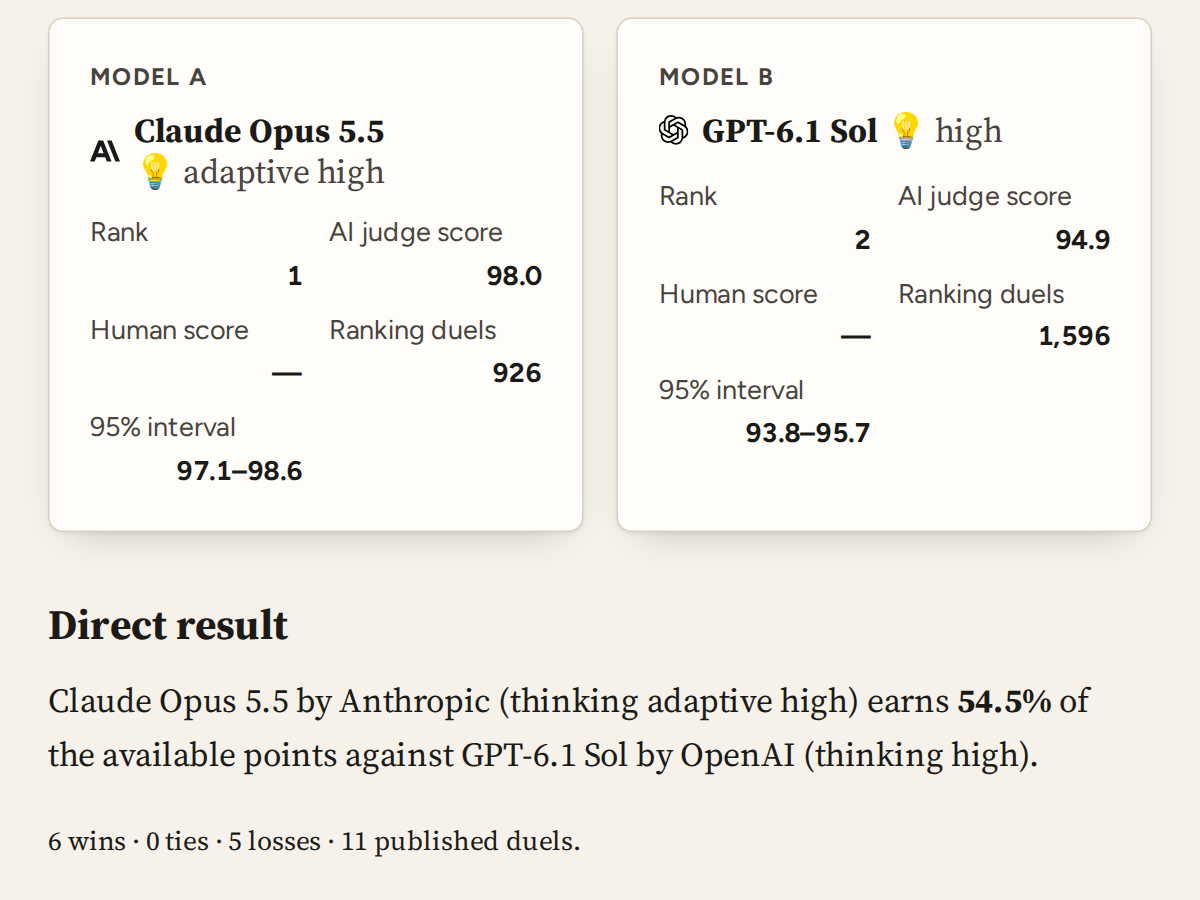
Our numbers come from a read only snapshot of the AI Writing Benchmark production database, generated on August 12, 2026 at 00:21 UTC. It covers 100 published pairwise judgments for the exact Muse Glimmer 30B K-Quant 17GB versus Muse Glimmer 30B K-Quant Dynamic pair: 25 in each of German, English, Spanish and French, drawn from 13 unique prompts per language. Two judges produced them, Claude Opus 5 (12 per language, 48 in total) and GPT 5.6 Sol (13 per language, 52 in total), clearing our floor of 12 judgments per judge, per language, per pair everywhere. The tables sit on our results pages. In English, Dynamic earned 64.0 percent of the points. That is enough to compare the two official quantizations with each other, and not enough to rank Muse Glimmer against other local models.
The head to head: K-Quant 17GB versus Dynamic
Meta ships two official text quantizations, so the first question is which file to download. Below, the percentage is the point share for the 17GB build: a win counts one point, a tie half. Above 50 percent favors 17GB.
- German: 40.0 percent. 10 wins, 0 ties, 15 losses across 25 judgments.
- English: 64.0 percent. 14 wins, 4 ties, 7 losses.
- Spanish: 34.0 percent. 8 wins, 1 tie, 16 losses.
- French: 40.0 percent. 10 wins, 0 ties, 15 losses.
Combined, Dynamic holds 44.5 percent of available points over 100 judgments. The 17GB build won German, Spanish and French; Dynamic won English with 64.0 percent there. The judges land in almost the same place independently: Claude Opus 5 gives Dynamic 44.8 percent over its 48 judgments, GPT 5.6 Sol 44.2 percent over its 52. By language, Claude has Dynamic at 41.7, 58.3, 37.5 and 41.7 percent for German, English, Spanish and French; Sol at 38.5, 69.2, 30.8 and 38.5. Two judges agreeing on direction in all four languages is the most reassuring signal in this dataset.
How much weight those numbers can carry
Less than the decimal places suggest. Twenty five judgments per language built from 13 unique prompts means each prompt contributes roughly twice, so a few prompts that suit one build can move a language by several points. Read every figure as an early direction, not a measurement.
The benchmark does not reproduce Meta's aggregate direction. Meta reports average degradation of 1.0 percent for 17GB against 0.2 percent for Dynamic, while our small sample favors 17GB in three of four languages. English is the only language favoring Dynamic, at 64 percent for Dynamic; with 25 judgments it could easily drift toward parity. It is a reason not to worry about 17GB in English, not evidence that the smaller quantization is better.
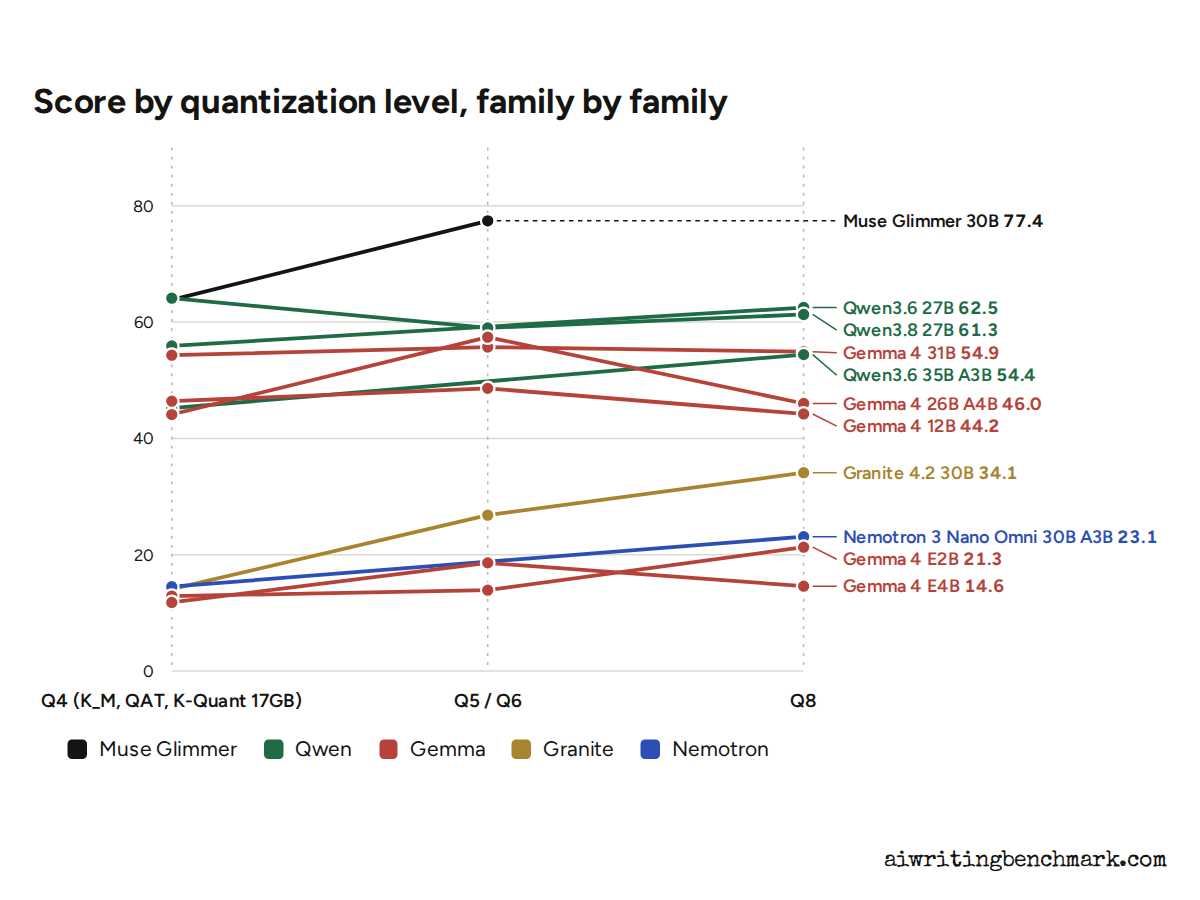
A larger limit: our snapshot contains no qualifying comparisons against other models at all for either variant. Gemma 4 and Qwen 3.6 peers of similar size are in the benchmark, but no exact pair against Muse clears the same 12 per judge, per language floor, so we cannot tell you where Muse Glimmer stands among local competitors.
Dynamic against 17GB in direct writing duels
Point share earned by Dynamic in the exact same-prompt comparisons. The red line marks parity.
View the data table
| Comparison | Value | Evidence |
|---|---|---|
| German | 40.0% | 25 judgments: 10 wins, 0 ties, 15 losses |
| English | 64.0% | 25 judgments: 14 wins, 4 ties, 7 losses |
| Spanish | 34.0% | 25 judgments: 8 wins, 1 ties, 16 losses |
| French | 40.0% | 25 judgments: 10 wins, 0 ties, 15 losses |
What Muse Glimmer 30B actually is
Meta Superintelligence Labs released the model on August 10, 2026 and announced it as an open agentic model. Meta makes no prose quality claim for it, so any claim about its writing has to be earned from outside evidence.
The official model card describes a dense causal transformer paired with a separate perception encoder, approximately 29.6 billion parameters of which roughly 1.8 billion sit in the vision encoder, across 52 text layers. It takes text and images and returns text. The configured context is 131,072 tokens; the knowledge cutoff is January 4, 2026.
That context is the clearest structural attraction for manuscript work, but capacity is not recall. Nothing in the available evidence shows how faithfully the model tracks detail near the top of a full context, so treat the number as headroom to test.
Meta says training data spans more than 100 languages but publishes no language list, no token count, no language proportions and nothing about creative writing material. Since our own results already differ by language, that silence is where any writer's trust has to start.
Where Opus and Sol differ on the same duel
Dynamic's point share in English, separated by judge. Both rows pass the 12 judgment floor.
View the data table
| Comparison | Value | Evidence |
|---|---|---|
| Claude Opus 5 | 58.3% | 12 judgments: 6 wins, 2 ties, 4 losses |
| GPT 5.6 Sol | 69.2% | 13 judgments: 8 wins, 2 ties, 3 losses |
Choosing a build: memory is the real constraint
The artifact sizes, from the official GGUF repository, are precise enough to plan around:
- K-Quant 17GB text model: 16.757 GB, target 24 GB of VRAM, reported average degradation 1.0 percent.
- K-Quant Dynamic text model: 19.654 GB, target 32 GB of VRAM, reported average degradation 0.2 percent.
- Optional perception encoder: 1.4 GB, needed only if you feed it images.
- Optional speculative drafter: 1.631 GB.
Loading everything brings the 17GB configuration to 19.79 GB and Dynamic to 22.69 GB, and those are artifact sizes before runtime and context overhead, since a 131,072 token context has to be held somewhere. Meta's 24 GB and 32 GB targets are more decision useful than the file names. Text only writers can skip the vision encoder, and the drafter earns its memory only once you have measured the gain on your own hardware.
The repository also documents the required llama.cpp build and supported runtimes. Front ends lag new architectures, so verify rather than assume support in LM Studio or Ollama, and check our local AI guides for current setups. If neither official artifact fits, Unsloth publishes runtime notes and lower memory alternatives.
The official quantization trade-off
Text-model file size. Runtime memory and context overhead come on top of these files.
View the data table
| Comparison | Value | Evidence |
|---|---|---|
| K-Quant 17GB | 16.8 GB | target VRAM: 24 GB; reported degradation: 1.0% |
| K-Quant Dynamic | 19.7 GB | target VRAM: 32 GB; reported degradation: 0.2% |
Privacy is real, and the speed numbers are not what they look like
Running locally removes the strongest reason to send an unpublished manuscript to a cloud provider, and for many writers that alone justifies the download. It does not make a workflow private by itself: local apps keep logs, plugins make network calls, and your source files still need access control and backups.
On speed, Meta reports decoding throughput with and without the speculative drafter: 74.9 tokens per second rising to 233.4 on an Nvidia RTX 5090, a 3.1x gain; 23.7 to 37.8 on an Apple M4 Max, 1.5x; and 26.6 to 50.2 on an Apple M5 Max, 1.8x.
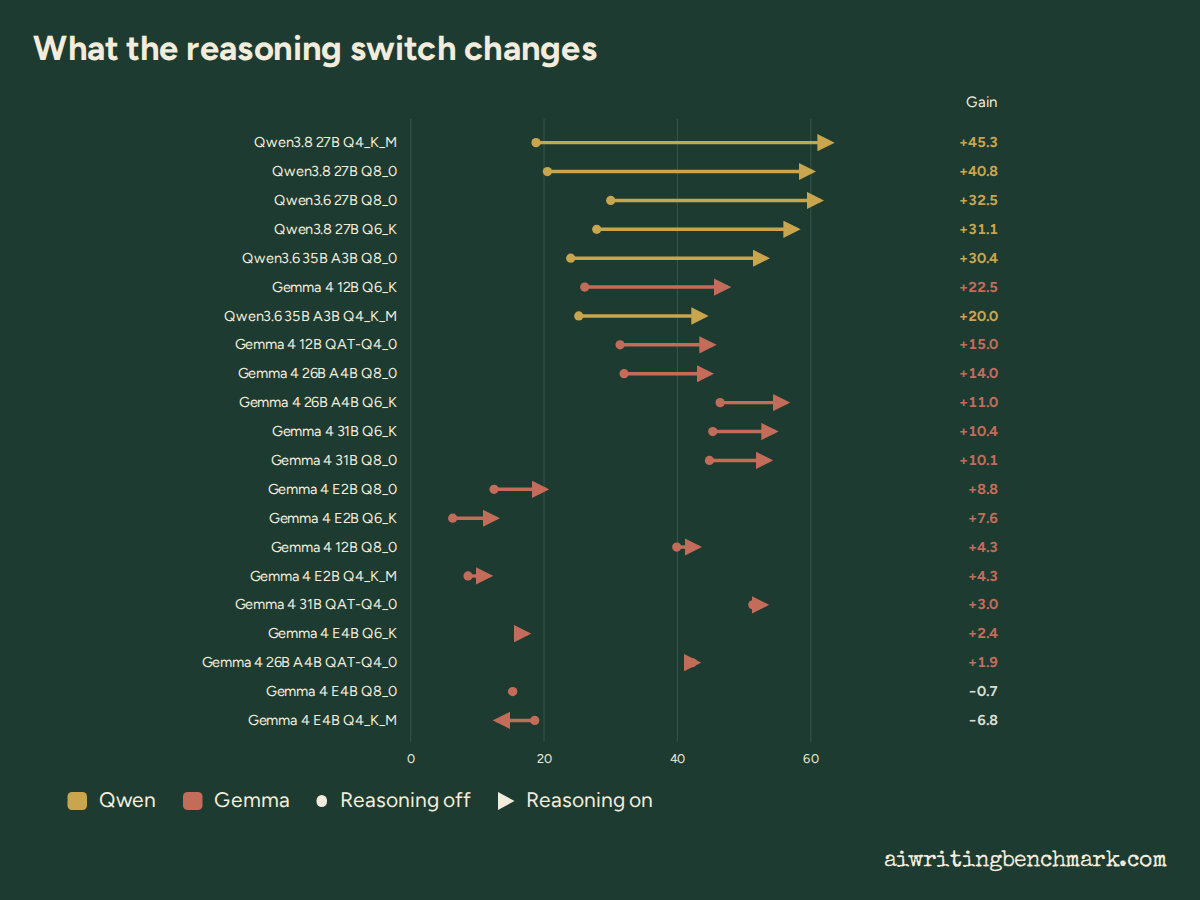
Read the conditions first. Meta measured at batch size 1 with greedy decoding, and its own guidance is not to promise those figures for sampled creative prose, which is how creative writing is almost always generated. The numbers compare hardware against hardware and confirm that the drafter helps most on the fastest GPU. They do not forecast how quickly a chapter draft appears. No data here isolates the effect of reasoning on prose quality or latency either, so benchmark that on your own prompts.
What DFlash changes in Meta's speed test
Tokens per second at batch size 1 with greedy decoding. Sampled prose can run at different speeds.
View the data table
| Comparison | Value | Evidence |
|---|---|---|
| Nvidia RTX 5090 baseline | 74.9 tok/s | baseline |
| Nvidia RTX 5090 DFlash | 233.4 tok/s | DFlash |
| Apple M4 Max baseline | 23.7 tok/s | baseline |
| Apple M4 Max DFlash | 37.8 tok/s | DFlash |
| Apple M5 Max baseline | 26.6 tok/s | baseline |
| Apple M5 Max DFlash | 50.2 tok/s | DFlash |
Independent evidence: mid table, with a factual risk warning
The Arena Creative Writing leaderboard snapshot of August 11, 2026 places Muse Glimmer at rank 135 of 384 models, with a style controlled score of 1372, a stated uncertainty of 23 points and 707 votes, giving a plausible rank interval of 107 to 155. The Writing, Literature and Language leaderboard from the same date has it at 127 of 385, score 1387, uncertainty 20 points, 926 votes, interval 97 to 151. Both snapshots are early, both intervals are wide, and neither identifies which quantization or reasoning strength voters used. Read it as a middle placement in a large field on human preference and ignore the exact rank. Muse was also absent from both EQ-Bench writing boards when we verified sources on August 11, 2026.
Artificial Analysis, in an August 10, 2026 snapshot, reports an intelligence index of 35, an openness index of 44, a GDPval AA v2 Elo of 953 against a human baseline of 1000, an AA Omniscience score of minus 33 and a hallucination rate of 82 percent. Those indicate general capability and factual risk, not prose quality. For fiction and for editing where you supply the facts, the hallucination figure barely matters. For sourced writing, every name, date, quotation and citation needs checking against a primary source.
Early external writing evidence remains uncertain
Arena style-controlled score with the published uncertainty interval. The two categories use separate vote pools.
View the data table
| Comparison | Value | Evidence |
|---|---|---|
| Arena Creative Writing leaderboard | 1372 ± 23 | 707 votes; rank 135 (107 to 155) |
| Arena Writing, Literature and Language leaderboard | 1387 ± 20 | 926 votes; rank 127 (97 to 151) |
The license line, and what we would recommend
The weights carry an Apache 2.0 label, unusually permissive for a model of this size and a genuine advantage if you intend to adapt or deploy it. It is accompanied by a separate Meta Usage Policy, so anyone describing this release as restriction free is describing half of it.
If you have 32 GB of VRAM or unified memory, test both builds. Meta reports lower average degradation for Dynamic, but our small sample favors 17GB in three languages and Dynamic only in English.
If you have 24 GB, the 17GB build is a defensible choice. It took 55.5 percent of points overall and led most clearly in Spanish, where Dynamic earned 34 percent. English is the exception: Dynamic earned 64 percent there.
On adopting it as your writing model: not yet. Muse Glimmer offers a private, long context drafting assistant that never leaves your machine, at mid table writing quality, with a hallucination rate that rules out sourced work without verification. That is useful to own, but it is not a reason to move a prose workflow onto it. Two things would change our view: qualifying AIWB comparisons against the Gemma and Qwen peers, and an EQ-Bench listing. We will revisit when either appears.